Rejuvenate your brand without losing sight of your identity
You’ve built something people recognize and love. Your brand has equity—real equity—that took years to establish. But lately, you’ve noticed it’s starting to feel a bit stale. Maybe your competitors’ brands feel fresher. Maybe your visual identity doesn’t quite match the sophistication of your products. Maybe you’re under new ownership, and everyone’s looking at the brand with fresh eyes.
You know something needs to change. But you also know you can’t just blow everything up and start over. You have loyal customers. You have team members who take pride in your brand’s history. Any established brand inevitably needs adjustment over time, but you can’t afford to squander all you’ve built.
Don’t misunderstand: Being a legacy brand is amazing. You’ve reached the level every startup aspires to reach. But when it comes to rejuvenating your brand, you’re walking a tightrope between securing the best of what you have and making room for what’s next.
And if you’re not careful, it’s a long way down.
Four key considerations for legacy brand refreshes
Every rebrand lies on a spectrum. Circumstances and directional changes sometimes demand a total brand reset. But you don’t need to tear things down to the studs. You need a stronger brand refresh or reframe that bridges the gap between where you are and where you need to be.
To move forward, you need to assess four key details:
Identify what’s sacred about your brand
Your first step is to identify quintessential element(s) of your brand.
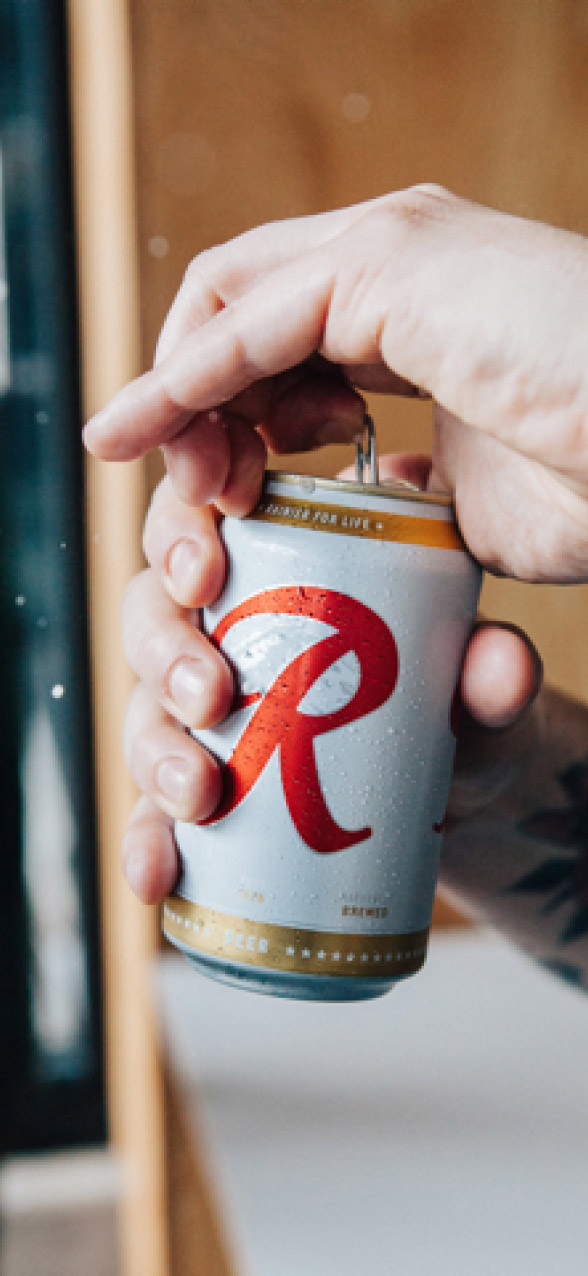
The good news? This part should be easy. Your team knows them. Your customers know them. When someone mentions Rainier Beer in Seattle, people immediately think of that big red “R.” It’s on a massive 30-foot installation on a downtown building. You simply can’t get rid of it.
The bad news? If you have found yourself sitting in a conference room with your team trying to identify what’s sacred about your brand, then we have bad news: there probably isn’t anything sacred.
The sacred elements of your brand exist on a spectrum. Some things are 10 out of 10, making them untouchable. Others might be 6 out of 10—they have equity and history, but they’re negotiable if they’re not serving the brand well. The trick is correctly identifying the difference because the consequences of losing what’s sacred can be disastrous.
Just look at Anchor Steam. The distinctive old-time labels had been a fixture for decades and were beloved by fans. Then they updated their look with generic gold-and-blue labels that abandoned the vibes that set them apart. Now they’re gone. They lost their one thing, and the market stopped caring.
Diagnose where your brand is weak
Having an iconic logo doesn’t mean you have a healthy brand.
When Rainier came to Parliament, they had one of the most recognizable beer cans in the Pacific Northwest. And when asked to share their brand materials, they sent packaging artwork files. That was it. No brand guidelines. No documentation. No standards. No kidding.
If you’re missing a crucial element like brand guidelines, execution will be inconsistent across channels. You may have a logo that doesn’t scale down for small applications, or outdated visuals that don’t accurately capture who you are. Or perhaps your documentation exists only in one designer’s head, leaving you one staffing change away from chaos.
Often, the weakness is exactly why you’re considering a rebrand in the first place. You can feel something’s not working. That weakness you’re feeling is the opportunity. It’s what needs to evolve.
Understand your practical constraints
Here’s where legacy brands face challenges startups don’t have to address. You have reach, infrastructure, and physical presence. Updating everything is expensive—and it takes time.
Financial Impact
When you’re a scrappy new brand, you update your website and refresh your pitch decks. That costs relatively little. But when you have manufacturing on multiple continents, hundreds of retail locations, established relationships with massive partners—that’s a different story.
Scope of Reach
The more established your footprint, the more complex the rollout becomes. Your new brand identity might need to live side-by-side with the old one for years. That’s a design constraint you have to account for up front. The old and new need to be different enough to feel fresh, but share enough that they don’t clash when sharing space on a shelf.
Timelines
Updating your brand is a time-consuming enterprise. Depending on your industry, physical elements may take even longer. Permanent signage. Environmental graphics. These don’t get updated right away—some might not get updated until they break down.
Here’s the hard truth: these practical constraints are why many legacy brands grow stale. There are logical justifications to defer the work. It’s an expensive, slow, and complex undertaking. Too often, 20 years can pass while your brand loses ground in the marketplace.
Navigate the emotional challenges tied to your brand
Your customers may have deep connections to your brand exactly the way it is. They’ll complain loudly on social media about any change. Just look at the manufactured outrage about Cracker Barrel’s rebrand. Public face-plants like that will make any brand scared to touch anything.
Just as challenging: your team might be emotionally attached to the old ways. When folks have been on your team for years, they remember the founder’s original vision. They have pride in the way things have always been done, however unconventional. They might see the suggestion that things need to change as an indictment of their work.
Recognizing and embracing the strengths and perspectives of your organization’s old guard and the new are key to addressing these challenges. Moving forward successfully requires a team effort, and that means ensuring everyone pulls in the same direction.
What rejuvenating a legacy brand looks like in practice
Parliament specializes in guiding brands through these kinds of changes. Here’s how we helped four legacy brands move ahead.
Rainier Beer— Building a brand system around a sacred element
What was sacred
The “R” was 10 out of 10 untouchable as an iconic part of the Seattle skyline, and the red, gold, and silver color palette was equally sacred. The wordmark had equity (maybe 6 out of 10), but it wasn’t embodying the brand attributes being defined, so it evolved.
Where the brand was weak
Despite having one of the most recognizable cans in the Pacific Northwest, Rainier had literally no brand guidelines. When asked to share brand materials, they sent us packaging artwork files. Everything beyond the can was figured out ad hoc by whoever was making it. Charming, but not scalable.
Practical constraints
Timeline was the primary constraint. It took 18 months just to get new cans to market because Rainier had to deplete existing inventory first. The rollout continued for another year as the old and new packaging coexisted.
Emotional challenges
The marketing team loved the "dirtbag brand" identity and took pride in succeeding for decades without formal guidelines. They initially fought the rebrand—the CMO at Pabst basically had to mandate it. But by the end, the lead who resisted ended up leveraging the rebrand as his signature achievement.
Fremont Brewing — Simplifying without sacrificing what’s unique
What was sacred
The heron on the brand’s logo was distinctive, and it needed to stay. The brand’s eclectic, illustrative approach to each beer—dinosaurs in space, giant krakens in the sky—gave each variety a personality that customers loved. That experimental spirit was core to Fremont’s identity.
Where the brand was weak
The original logo was very detailed and ornate. It looked great on tap handles but was unusable at small sizes. The illustration approach was charming but had zero standards. The overall system was clunky and unsophisticated.
Practical constraints
Similar timeline to Rainier: 9 to 18 months for can rollout, even longer for physical tap handles and signage. The complexity was amplified because Fremont creates many varieties of beer and constantly cranks out new flavors and limited runs.
Emotional challenges
The owner is passionate about beer. He needed to be sold on brand importance as a key way to create differentiation in an overcrowded market.
Just Food for Dogs — A drive to scale
What was sacred
Less clearly defined since it was a relatively young brand focused on growth rather than heritage. The mission of providing human-grade fresh food for dogs was core to the brand’s mission, but its visual identity was more flexible.
Where the brand was weak
The brand wasn’t positioned for the retail scale necessary to achieve profitability. Fresh dog food brands lose money on direct-to-consumer shipping. Retail partnerships offered a clear path forward, but the brand needed to work harder across multiple channels.
Practical constraints
Costs. Updating retail signage across all Petco and PetSmart locations was prohibitively expensive at over a million dollars. Private equity owned the company with a three-to-five-year exit timeline, and investing that much in signage didn’t make business sense. The logo refresh had to be similar enough that old and new versions could sit side-by-side.
Emotional challenges
All new leadership brought in by PE reduced resistance at the top. But the broader team was loyal to the founder’s original values. The solution: keep the existing "values" and add new "principles" that reflect the direction PE wants to head, providing a way to honor the emotional attachment while moving forward.
Marzocchi — Resurrecting a dormant brand with contemporary edge
What was sacred
Older mountain bike riders remembered Marzocchi fondly as one of the first suspension fork companies with a maverick, rebellious attitude from the 90s. That edginess needed to carry forward, but in a contemporary way.
Where the brand was weak
The brand hadn’t existed for 15 years—Fox bought the intellectual property to offer products at lower price points than the company’s premium components. The original brand execution was edgy to the extreme with porn star spokespeople, women in bikinis, and extreme colors. Not just wrong for Fox’s more corporate culture, but wrong for today’s times.
Practical constraints
The brand needed to fit within Fox’s portfolio without creating confusion or undermining Fox’s premium positioning. It also had to work with Fox’s existing manufacturing and distribution infrastructure while maintaining a distinct personality.
Emotional challenges
Lighter than the other examples since the brand was being resurrected. There was no existing team with attachment to how things were. The challenge was honoring nostalgia for people who remembered the brand’s pioneering early days while making it work for new riders. The solution: a modern interpretation of edginess—the "M" shares DNA with the original (angular, bold—a bit Metallica-esque) but executed with modern sophistication and built-in room for expression.

A vision-forward approach to rejuvenating your brand
You might be wondering: what about focus groups? What about customer research?
Here’s our philosophy: If you need focus groups to convince internal stakeholders, you probably don’t have the leadership alignment you need for a brand refresh to work.
Focus groups are backward-looking. They tell you what customers have liked in the past—not what they’ll love in the future. Think about the iPhone. If Apple had asked customers in 2006 what they wanted in a phone, exactly zero people would have said "a buttonless device with apps." Everyone loved BlackBerry’s keyboard. Apple had a vision for what would work five years out, not what was working right now.
That’s the kind of leadership we work with. Owners, CEOs, and CMOs focused on the next 20 years, not just the last 20. Leaders who understand that you sometimes need to make what customers will love, not what they say they want today.
Vision has to come from the top. When you have that alignment and leadership is ready to make difficult decisions, that’s when you can do the work that positions your brand for the next chapter while honoring what made it great in the first place.
Move forward with confidence
You know something’s off about your brand, something in the details that is holding you back. The road ahead is treacherous, but the cost of inaction compounds incrementally, quietly. If you don’t move forward now, you’re facing more of a crisis than an opportunity.
With the right framework—identifying what’s sacred, diagnosing where you’re weak, understanding your constraints, navigating the emotional dynamics—you can do this successfully. You can honor heritage while embracing evolution.
Your legacy brand got to where it is for a reason. Now the question is: where does it go next? Let’s talk it over.

Introducing private equity to your business can easily create friction. Review six areas that deserve special attention during this critical inflection point.
Download