How fast food companies optimized away joy and world building
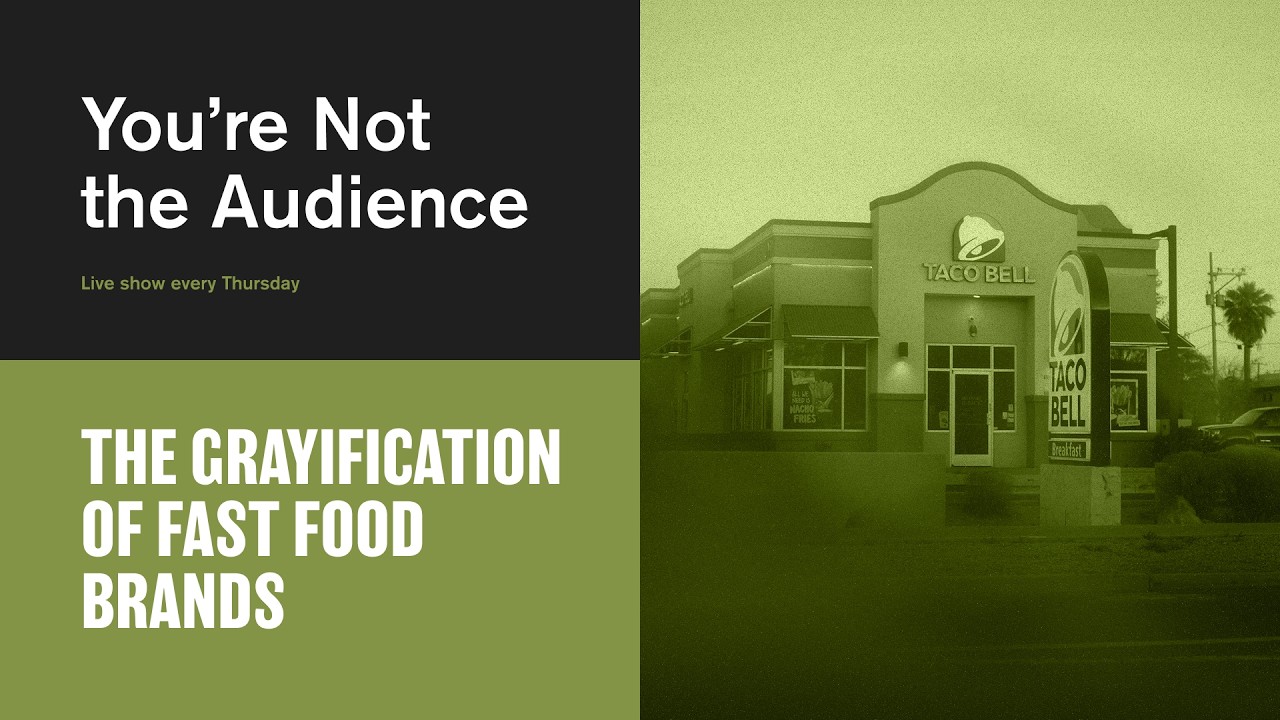
Optimization is the antithesis of joy, and fast food brands are proof. In this clip from You’re Not the Audience, Parliament Creative Director Calvin Ross Carl looks at how McDonald’s once nailed world building through murals, play places, and characters like Grimace and the Hamburglar, and how those spaces became corporate gray boxes ordered through screens. He explains why mascots like the ones Parliament has created for Rainier Beer create worlds people want to explore, why heritage is nostalgia weaponized for the future, and why sameness is so dangerous in a category where everyone sells the same thing. It’s from the You’re Not the Audience episode on fast food brands, The Grayification of Fast Food Brands.
Watch the full episode
Outline
Summary
Calvin Ross Carl argues that the efficiency mindset in boardrooms and brand teams is destroying world building and moments of joy. World building lives on the periphery of a brand, the fun stuff that doesn’t make the early pages of the brand book, and McDonald’s was once legendary at it, from Wes Cook’s murals in Washington State, documented by Cabel Sasser of Panic, to play places, Nintendo 64 setups, and characters like Ronald, Grimace, and the Hamburglar.
Physical spaces should invite people into a new world and give them permission to be someone else. Instead, fast food locations have become corporate gray boxes that look like tech headquarters. Calvin hopes for a return of mascots, pointing to the characters Parliament has created for Rainier Beer.
Optimization improves profits, he says, but it’s the antithesis of joy, because joy takes time. Ordering at a screen removes the human moment, and in a category where everyone sells cheeseburgers, giving up every nuanced way to stand out means people fall out of love with your brand.
Highlights
McDonald’s once nailed world building through murals, play places, and characters.
Fast food spaces have become corporate gray boxes.
Optimization is the antithesis of joy.
Heritage is nostalgia weaponized for the future.
Sameness is especially costly when products are nearly identical.
Key insights
World building lives on the periphery
The details that never make the brand book are often what fans remember and explore most.
Spaces should grant permission
A great physical experience lets people act in ways they normally wouldn’t, like an adult who still wants into the play place.
Joy takes time
Joy can seem frivolous, but shared joy is one of the great unifiers, and it can’t survive a relentless push for speed and profit.
Use heritage as a strength
Going back to old symbols and messaging can turn nostalgia into something that powers the brand forward.
Detailed analysis
The clip is careful not to dismiss profit. Calvin acknowledges that optimization works and that his job is to help companies keep existing. His critique is about what gets cut along the way: the mascots, spaces, and human service that once made each chain distinct.
The strategic argument is about differentiation. When McDonald’s, Wendy’s, and Jack in the Box all sell similar products, the nuanced brand experience is the main thing that can set them apart. Removing it trades long-term love for short-term margin.
Conclusion
Maximizing profit is fine, Calvin says, but for how long? Brands that protect joy, lore, and mascots give people a reason to keep coming back.
Transcript
So, one other thing that I think is kind of a casualty of this efficiency mindset, that I think a lot of the boardrooms and a lot of the brand teams are probably doing during this: focusing on efficiency starts absolutely destroying your world building and your moments of joy within the brand. And fast food companies, some of them are just absolutely legendary at world building. And when I’m talking about world building, I’m talking about all those little things that are just along the periphery of your brand, that don’t necessarily make it into the early pages of your brand book, but they’re all the fun stuff. They’re the deep exploration that people can do to discover more about you. And no place did this better than good old McDonald’s here.
I mean, McDonald’s nailed world building and joy in a way that I just think few have. When I’m talking about world building this way—I also included a link to this down below—these are murals from McDonald’s in Washington State, all by this one artist named Wes Cook. Cabel Sasser from Panic Software did this amazing deep dive into this artist, these murals, how he discovered all of them. And this is the stuff that creates world building. And McDonald’s was great at it. We had Ronald, we had Grimace, we had the Hamburglar, and all of those little things create sticky moments that we’ll never forget. That creates a world that we can fall into.
Yeah. Sarah says, “RIP the good times in the McDonald’s PlayPlace.” Yeah, look at this. The PlayPlace. Just incredible. I’m just sad that they won’t let adults in it. By the way, this article that Cabel Sasser wrote is just full of tons of gems from the heyday of McDonald’s. There are even the leftover Nintendo 64 setups that they had here, for some reason, just sitting there. Look how dusty that thing is. It’s barely been messed with, but it is such a gem. That was such an amazing time. So that is a great example of world building in these fast food brands.
And I think what a lot of places forget when you are creating an interior space or a physical experience: the whole goal of that is to invite people into a new world, unlike any world they’ve been in before or any world they regularly exist in. It’s creating a space where they give you permission to be someone else, to enjoy something else, to do something you wouldn’t do normally. And that is what all of these spaces were very good at. You get to go to the PlayPlace. You get to take your kids there. You get to be a kid there and play in a way that you wouldn’t normally get to. You get to play the Nintendo 64. You get to go to Taco Bell and have your tacos in this place that doesn’t look like what your house looks like. A completely different, memorable experience.
But all of those places have become these corporate gray boxes now. Every single one looks like it’s meant to be some tech company’s headquarters, as opposed to an actual fast food place where you enjoy a nice little cheeseburger. Also, just the fact that—what happened to mascots? I just mentioned earlier that Burger King brought back the King, or made the King an actual character. And God, I hope we get back to an era of mascots. I think we’re close. I think mascots are so good at just instantly creating this whole world building.
We talked last week about how we’ve created some mascots, essentially, for Rainier Beer, like Kandalf the Gold, and we use the Wild Rainiers, the roaming bottles that are kind of like deer, but they’re replaced with beer cans and beer bottles. All of those things add up to a world that people get excited about, and it creates a world that people actually want to explore.
So with that move to maximum efficiency, you have to cut out complex and nuanced brand worlds, because those distract people, and there’s no more world building. There’s no more lore. There are only dollars. And once you start doing that, though, it works. It definitely works. It improves profits, and that’s great, especially as a brand person. My job, usually, as a brand person, is to ensure that the company keeps existing and making profit. I like that. Profit is okay. But when you do it at the expense of destroying joy, that is a big problem, because joy is such a powerful thing for fast food brands. So they’ve started optimizing away joy.
And so why is that a problem? I mean, even just here in the comments, everyone’s got these little tiny memories of moments in fast food places, and you can’t get that experience at them anymore. Okay, so let’s talk about optimizing away joy. Let me think of the exact way I want to put this. I think a brand that focuses on optimization is often at the complete opposite point from creating joy. Optimization is the antithesis of joy. And the reason I say that is because joy takes time. It takes time to swell. It takes time to feel it. And time is not on our side when we just want maximum profit.
And I think we also just have this idea that joy is frivolous, but joy is also just beautifully important. It’s actually the moments we don’t forget. When you share joy with other people, it’s one of the greatest unifiers of mankind. And so when you go into a McDonald’s now, or you go into any of these stores where you actually aren’t even greeted by a person, you’re greeted by a screen where you order on screen. I know a lot of people say they enjoy that because it cuts out the human experience. That’s fine for that person, but that is very bad from a brand perspective, because nothing about that experience is creating joy and generating joy for that person in a unique, distinct brand way. You don’t get that moment of friendliness with the person.
Yeah, [unclear] says joy turns into nostalgia, which keeps a customer base. Yeah, absolutely. I haven’t talked about nostalgia during this. I think of heritage and nostalgia as being essentially kind of the same thing. I think heritage, in my mind, is nostalgia weaponized for the future. So I think that’s kind of how heritage and that nostalgia can actually be morphed into something for the future. You go back, you look at all those symbols, at all that old messaging, and you can use that as a strength. Aaron says, “I’m going to quote that.” Oh, good. I already forgot what I said. Something about weaponizing.
Okay. So I think that is the difficult part: they’re just getting rid of joy when they’re doing this. Cool, you can order a Coke, and you can add some vanilla, you can add some cherry to it. It’s a very hyper-specific, personalized experience. But nowhere during that experience did I feel like somebody actually helped me do that. No one actually was like, “Here, let me provide the service for you.” And so now all of these companies are just becoming the most generic tech company, where you’re getting the same experience everywhere.
And that’s incredibly bad in a category of consumer goods where everyone kind of does the same thing. I mean, everyone’s got their preference: McDonald’s, Wendy’s, Jack in the Box, whatever. But they’re all in the cheeseburger business, or, in Jack in the Box’s case, the really terrible deep-fried taco business. And I think when you share such similarity in products, if you don’t take a chance to stand out and make your distinction in all the other millions of complex and nuanced ways you could, you’re just really dropping the ball, and then people fall out of love with your brand. Sure, you’re maximizing profits, but for how long?
And I think that’s a thing that it feels like they’ve all lost track of. Maybe some of this stuff does make me feel like I’m just an old man screaming at a cloud. I am 41 today. So maybe I’m officially at old-man-screaming-at-cloud age.